


• Launch

Polaris Dawn : SpaceX Makes the First Private Spacewalk

Published on 12 September 2024

The Polaris Dawn mission took four astronauts up to 1400 km above the Earth. This mission, launched by SpaceX, made the first two private spacewalks on September 12.

Polaris Dawn : SpaceX Makes the First Private Spacewalk
It took two and a half years of training and developing equipment for the Polaris Dawn mission to see the light of day. Led by American billionaire Jared Isaacman, it made it possible to conduct the first two private spacewalks on September 12. The crew also reached an altitude of 1400 km on September 11. It is the most distant manned mission in Earth orbit.

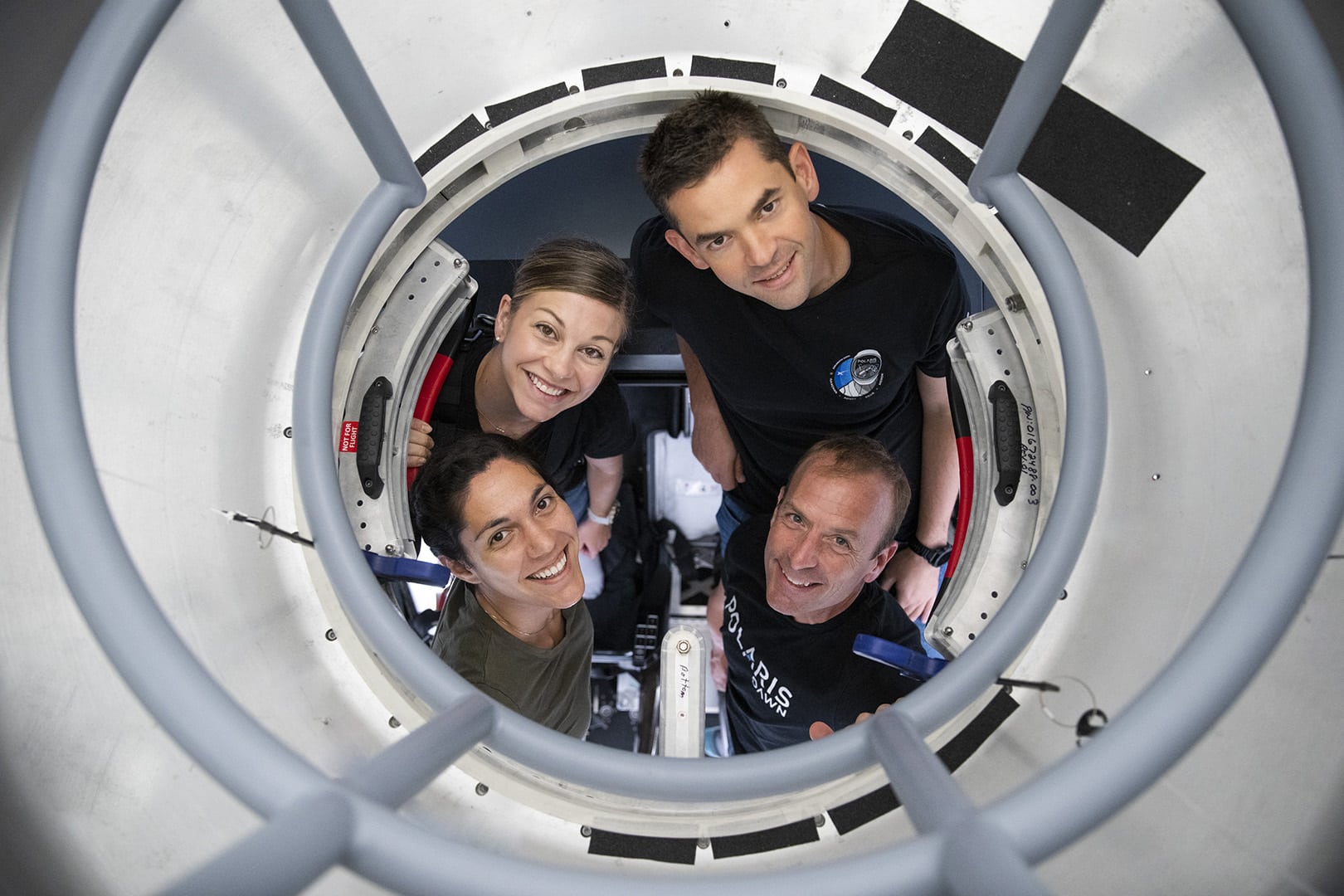
Anna Menon, Jared Isaacman, Sarah Gillis and Kidd Poteet were the four crew members of Polaris Dawn.

© Polaris Program – John Kraus

What Were the Objectives of the Polaris Dawn Mission?

Lasting Five Days, the Polaris Dawn Mission Aimed in Particular to Test SpaceX’s New Spacesuit

The Polaris Dawn mission is the first fully private mission to conduct a spacewalk. The crew was made up of four people. Two men and two women.

  • Commander Jared Isaacman, a 41-year-old American billionaire, was in This is not his first attempt since he had financed and participated in Inspiration4 in 2021, the first entirely civilian mission.
  • At his side, Scott “Kidd” Poteet was the mission pilot. This US Air Force Lieutenant Colonel spent twenty years in the army.
  • Sarah Gillis had the role of mission specialist on behalf of SpaceX where she is an engineer. In particular, she participated in improvements to the capsule and the suit to allow a spacewalk.
  • Finally, Anna Menon, also an engineer at SpaceX, had the role of mission specialist and medical manager.
Intense Training and State-of-the-Art Equipment

The Crew Trained for the Last 36 Months to Take Part in This Mission

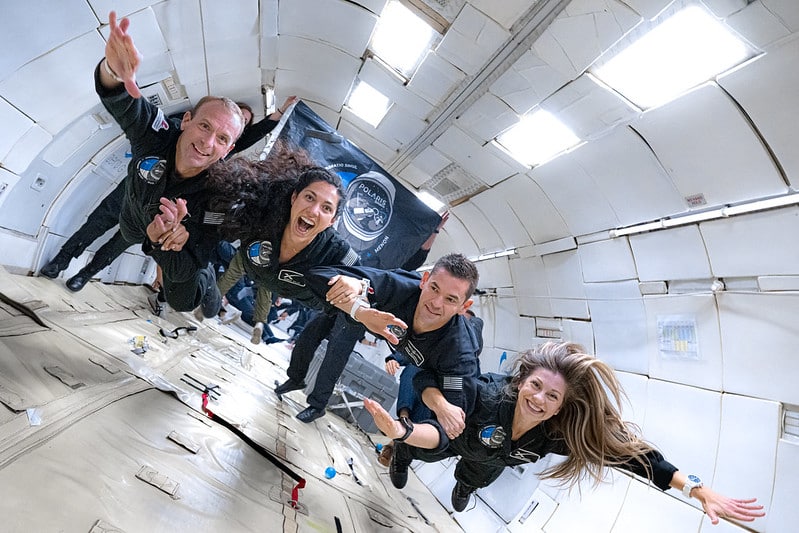
“It was very intense,” acknowledged Kidd Poteet at the press conference on August 19 at the Kennedy Space Centre. However, the former lieutenant colonel of the US Air Force is familiar with demanding training. Nonetheless, he said that in the twenty years he spent in the services, he had spent 1,500 hours in a simulator to prepare for air combat. However, for this mission, 2000 hours of simulator training had been necessary over the past thirty-six months. The four crew members went through theoretical, physiological, practical training etc.. They also prepared themselves for emergency procedures in case of problems. Kidd Poteet detailed the sessions in a vacuum chamber, in a centrifuge, in zero-G flight, and so on. The crew also did diving, alpha jet flying, high-altitude hiking and parachute jumping. “We spent the two and a half years together and we became a family to be ready for this mission,” commented Jared Isaacman.

The Polaris Dawn crew was trained in particular to deal with weightlessness on the zero-G flight.

© Polaris program – John Kraus

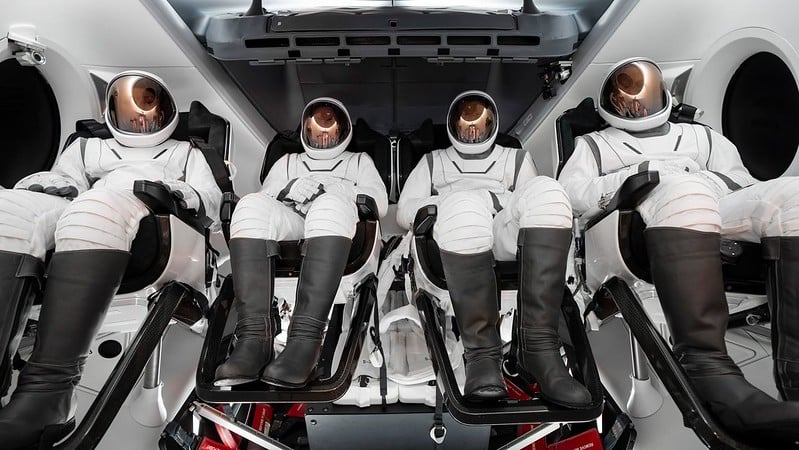
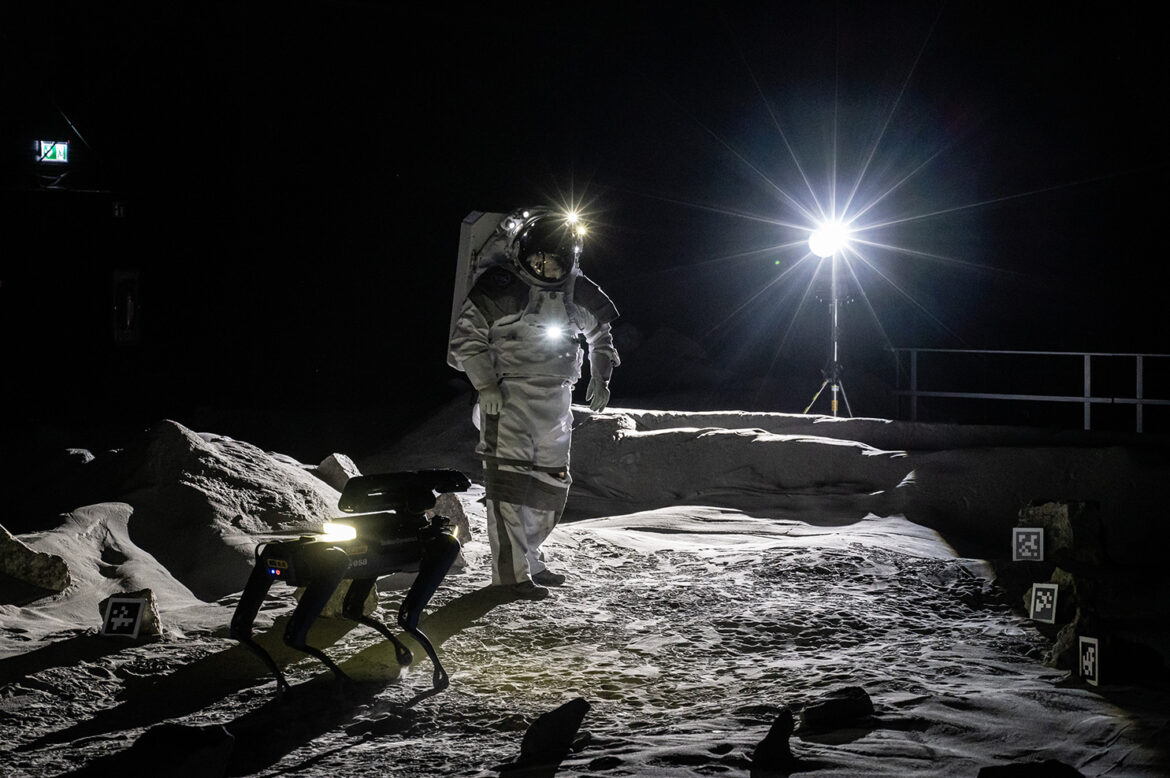
La combinaison de sortie extravéhiculaire est une évolution des tenues des astronautes à destination de l’ISS.

© Polaris program – John Kraus

An Ultra-Modern Spacesuit

The spacesuit for the spacewalks was the main element to be tested for this mission. This is a development of the flight suit (IVA Intravehicular Activity suit) used by  Crew Dragon members for the ISS. Less bulky and seemingly more manoeuvrable, it should enable better mobility than the spacesuits for spacewalks currently used on the ISS. The helmet is equipped with a head-up display, which projects information (temperature, oxygen, etc.) directly on the visor. As for the visor, it is covered with a layer of indium-tin oxide which offers it good transparency with an anti-fog treatment allowing good protection against the Sun. The fabric of the suit facilitates movement while regulating the temperature. “We would think that it will be extremely cold in the void of space,” explained Sarah Gillis, who as an engineer at SpaceX worked on the design and development of the suit, but we were more worried about being too hot.”

The Polaris Dawn Mission Reached an Altitude of 1400 km

Record Broken for the Dragon ‘Resilience’ Capsule and its Crew

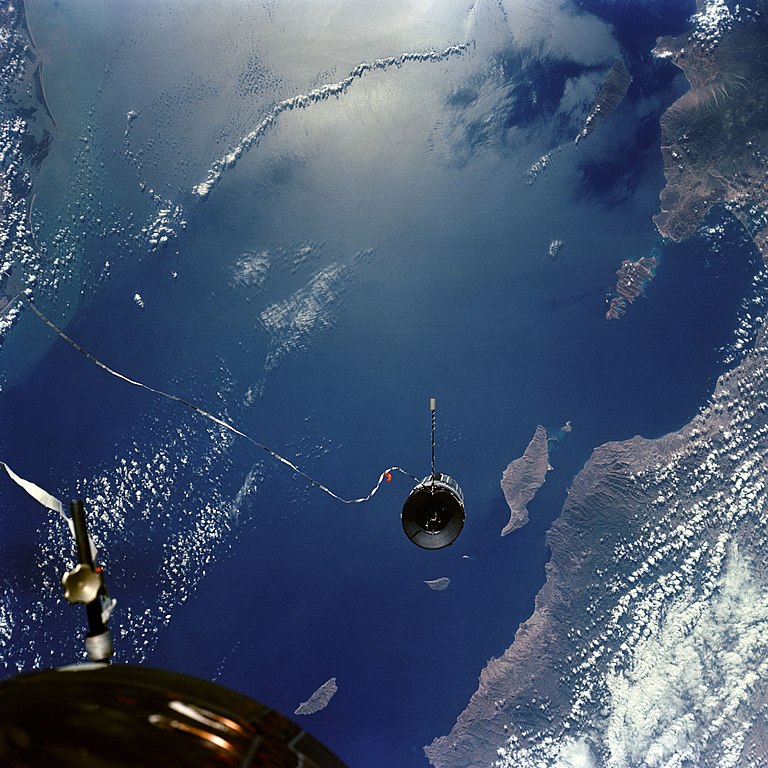
Initially, the crew were on an elliptical orbit with a 1200 km peak. Then, after a boost, the four members of the mission reached an orbit peaking at 1400 km. This is the furthest distance for a manned flight since the Apollo missions more than fifty years ago, and the furthest for a manned mission in Earth orbit. Previously, the record was held by the  Gemini 11 mission in 1966. Sarah Gillis and Anna Menon are also the first women to travel such a distance from Earth. A record that could be quickly broken by Christina Koch who is to participate in the Artemis II mission  in September 2025. Throughout the mission, the perigee, i.e. the moment when the capsule, still in elliptical orbit, is as close as possible to Earth, was at a height of 190 km.

In 1966, the Gemini 11 mission reached an altitude of 1374 km. © NASA

Two Spacewalks in the Void

In turn Jared Isaacman and Sarah Gillis Went Out into Space

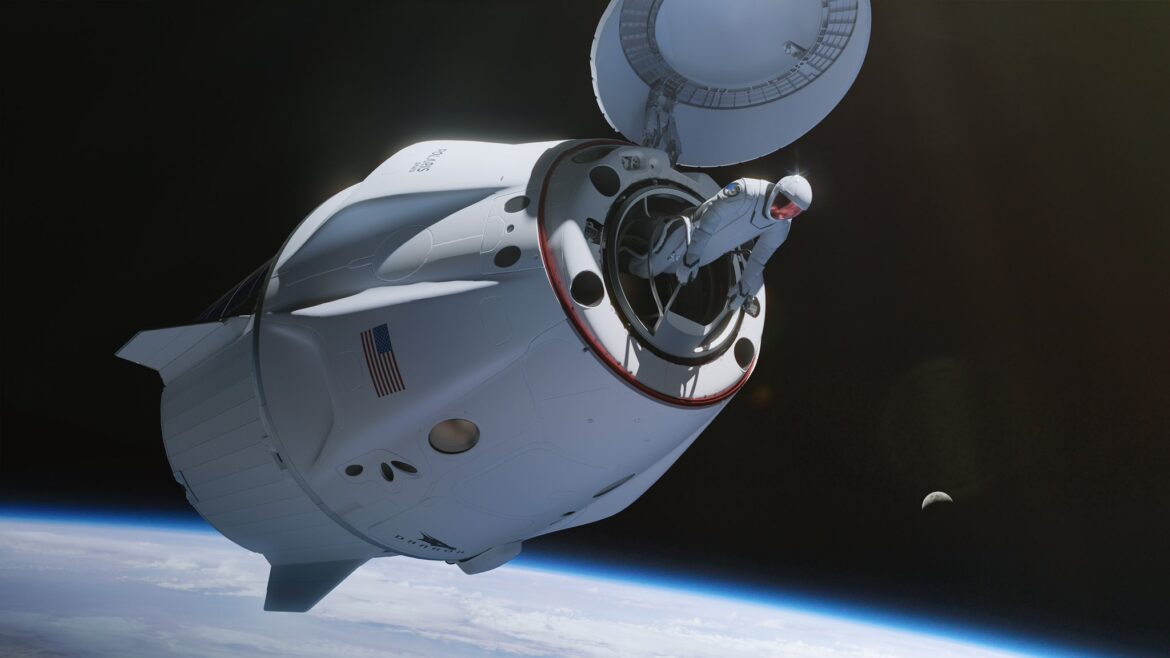
On September 12, from 12 noon, the sequence of the two spacewalks, the culmination of this Polaris Dawn mission, was launched. It was first necessary to don the SpaceX suit and check for possible leaks. Then, each crew member closed the visor to create a vacuum in the capsule. While only Jared Isaacman and Sarah Gillis had to go out of the capsule, all found themselves in the vacuum of space since the Dragon does not have an airtight zone that can remain pressurised. An umbilical cord of several metres ensured each person’s life support. Then, Jared Isaacman was able to unscrew the handle that seals the airlock located in the nose of the capsule and open the capsule.


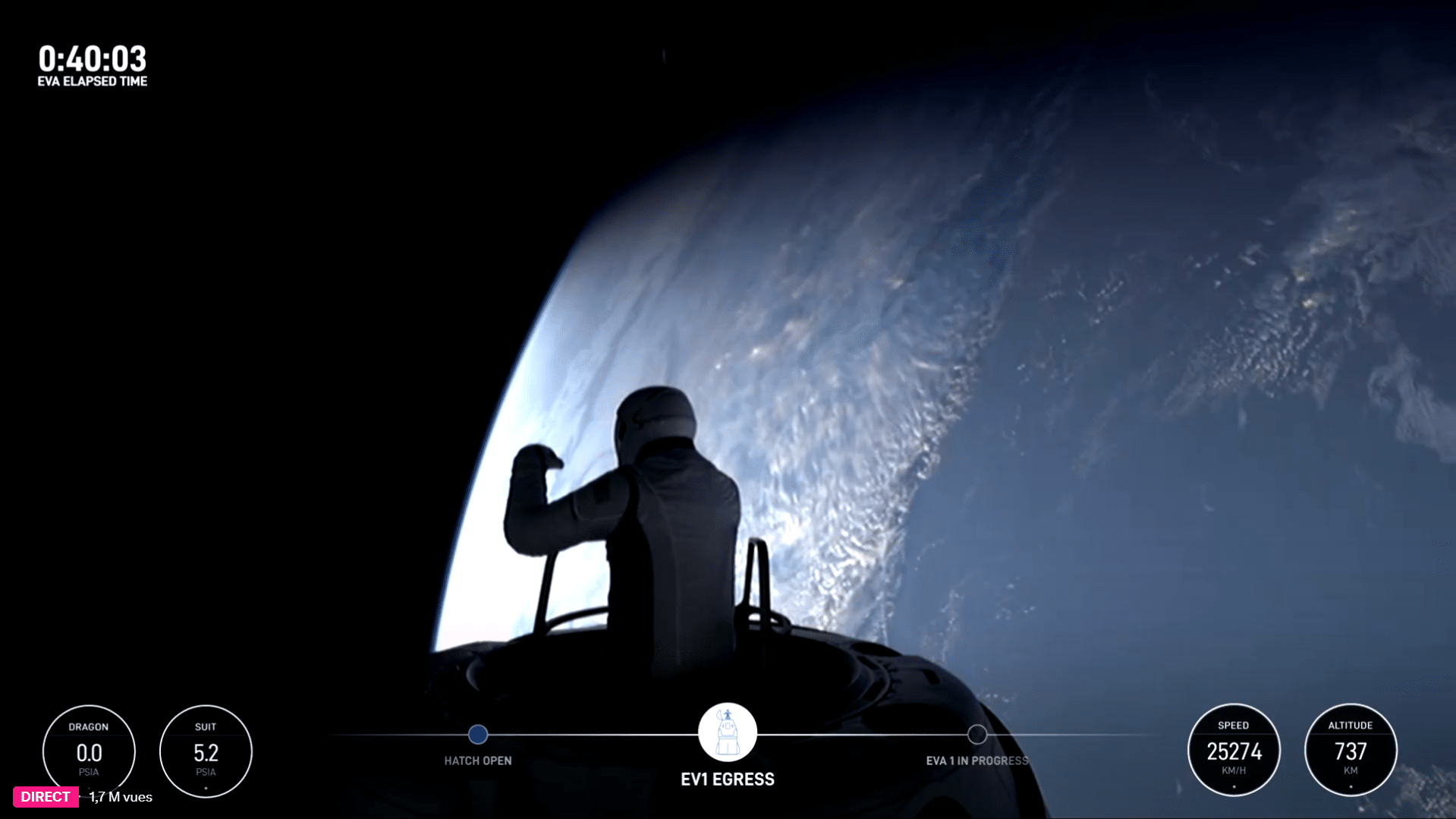
Jared Isaacman lors de la première extravéhiculaire de la mission privée de SPaceX Polaris Dawn. On le voit dans le sas de la capsule Dragon Resilience face à la courbure de la Terre.

Jared Isaacman moved his arms several times to test the manoeuvrability of SpaceX’s new suit.

© SpaceX

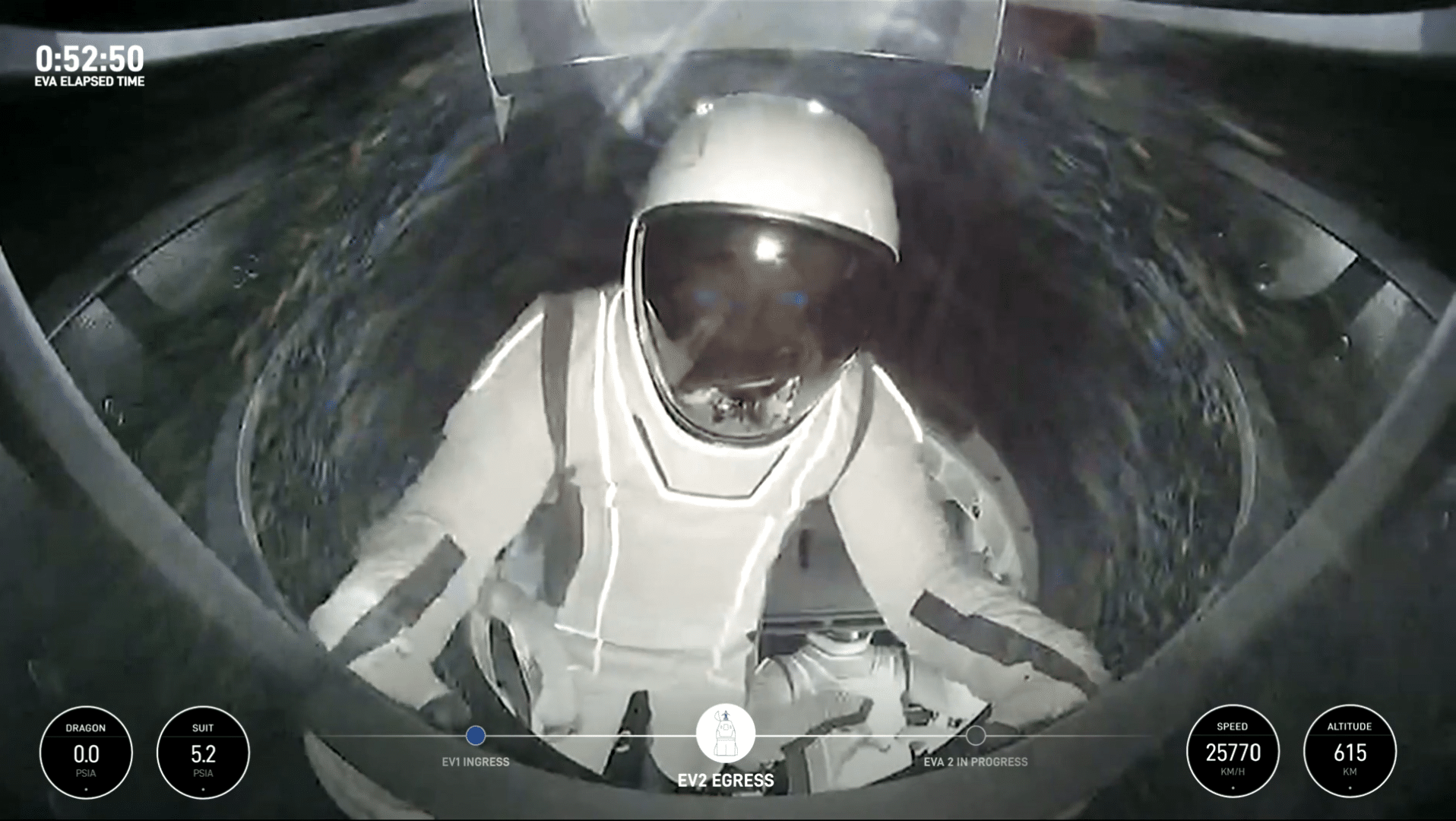
Sarah Gillis sort du sas de la capsule Dragon Resilience lors de la deuxième sortie extravéhiculaire de la mission de SpaceX Polaris Dawn.

Sarah Gillis sort du sas de la capsule Dragon Resilience lors de la deuxième sortie extravéhiculaire.
© SpaceX

Two Short Spacewalks

The New Suit Showed Its Effectiveness and Manoeuvrability

Slowly, the billionaire climbed outside. The camera installed on his helmet revealed an incredible landscape. Another camera, installed outside the capsule, made it possible to see it happen. After a few test movements, he quickly returned to his seat in the Dragon. It was then Sarah Gillis, an engineer at SpaceX, who worked on the suit, also went into the hatch. She went out for a few minutes before also returning to her place in the capsule.

As soon as the massive door of the airlock closed the capsule was repressurised to end the sequence.

Relive the Highlights the First Private Spacewalk

Jared Isaacman and Sarah Gillis Went Out One After the Other Through the Dragon ‘Resilience’ Capsule Airlock

Successful Return for Polaris Dawn

The Four Polaris Dawn Mission Astronauts Returned on Sunday, September 15

It was a little after 9 a.m. (Paris time) on Sunday, September 15, when the Resilience capsule returned to the atmosphere and landed at the  Dry Tortugas site, off the coast of Florida. Jared Isaacman, Sarah Gillis, Anna Menon and Kid Poteet could not hide their enthusiasm on coming out of the Dragon capsule.

“We Have a Suit Now! ”

Le On September 17, during a SpaceX event on X (ex-Twitter), the crew members delivered their impressions. “We have a suit, now!” declared Jared Isaacman. “It’s a private adventure that benefits all of humanity,” he continued. “We know that it works in the space environment and we have stored a lot of data to improve it, until one day people can use it on the Moon or Mars.” The billionaire also confided his experience of the spacewalk. “It’s an emotional experience, a sensory overload,” he admitted. “It’s a physical effort. The pressure changes, the temperature changes. It’s a little colder. Then there, you are immediately warmed up when you see the Earth with no other barrier than the visor of the helmet. Many senses are involved at the same time, much more than during my first experience in orbit,” said he who was previously a member of the Inspiration4 crew in 2021.

On September 13, astronaut Sarah Gillis recorded this song called Harmony of Resilience, to support St Jude Children’s Hospital and the access to music for all programme, El Sistema USA.

 © SpaceX

Why this Polaris Dawn Mission?

The Polaris Dawn Mission is Part of SpaceX’s Long-Term Project to Colonise Mars

Elon Musk, the boss of SpaceX, has often explained his intention to make humanity a multi-planet species. While we may doubt the feasibility of such a project, his stated ambition in particular is to participate in the colonisation of Mars. One of the main objectives announced by Jared Isaacman is therefore to “develop and test new technologies to support SpaceX’s project of a multi-planet life”. The tests carried out on this new suit should thus make it possible to develop it. “One day someone could be wearing a version of this suit on Mars and it is a great honour to have this opportunity to test it in this flight,” explained the mission commander.

In addition, about thirty universities and institutes entrusted around forty experiments in total to the Polaris Dawn mission. “We will use all the time available for science and research,” said Jared Isaacman.

Finally, the crew will try to connect to the internet thanks to a laser transmission using SpaceX’s Starlink satellites as a relay.

multiplanetary

SpaceX and its iconic boss, Elon Musk, make no secret of their ambition to colonise the planet Mars and broadcast visuals that make the Starship the main vehicle to carry out this enormous project.

© SpaceX – Artist’s impression

Other Missions to Come

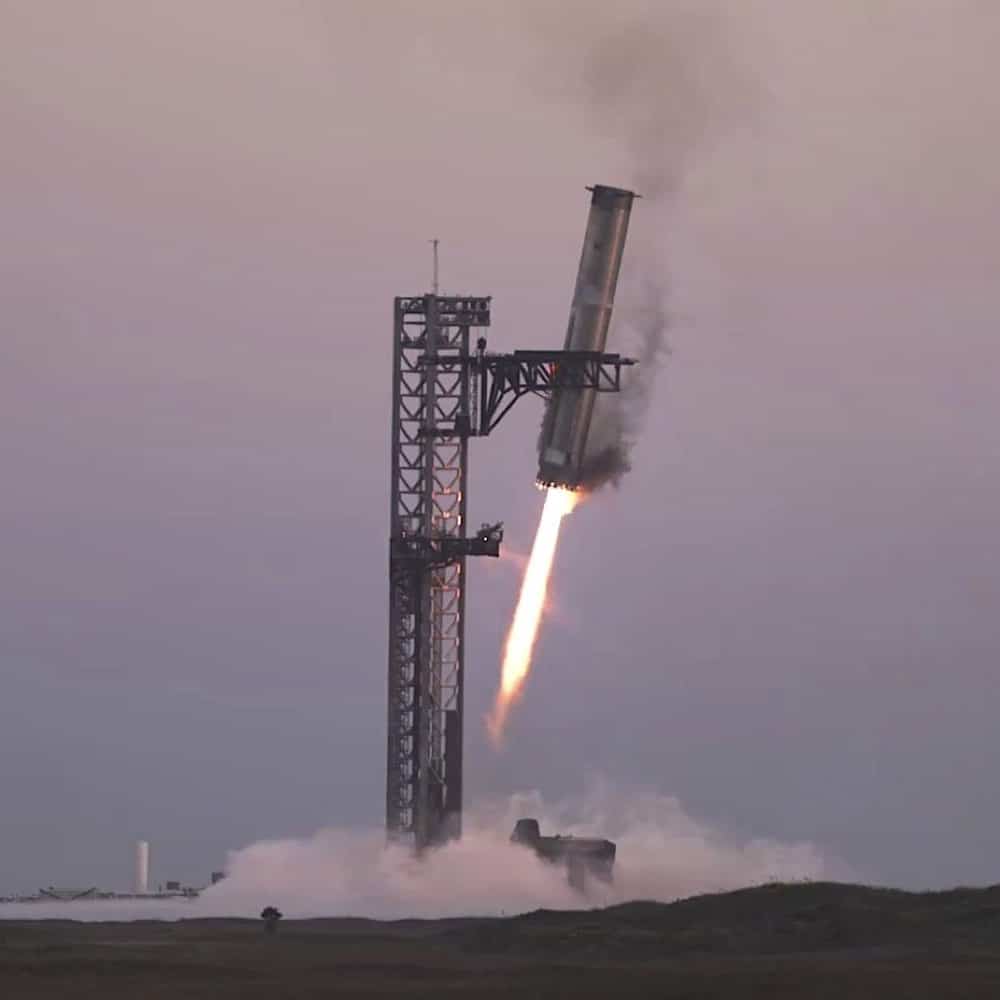
Polaris Dawn is only the first of three missions planned in the Polaris program. At the end of this flight, Polaris II will be scheduled. Still planned using a Falcon 9 and Dragon capsule, it will benefit from the feedback from Polaris Dawn. Finally, Polaris III should be the first manned mission for SpaceX’s Starship. The world’s most powerful launcher is not yet operational, although the latest test has shown significant progress. We know that the Starship is to serve as an HLS  (Human Landing System), i.e. as a lander for the Artemis III mission that is to take astronauts to the surface of the Moon. Until then, the certification stages for this ship, and in particular Polaris III, are numerous. Time is ticking away to meet deadlines with NASA is still talking about its manned Moon mission for 2026.

Related articles