Share
Published on 02 November 2015
Since 2 November 2000, the International Space Station (ISS) has always been home to a crew of between 2 and 6 people. A programme that unites the U.S., Canadian, European, Japanese and Russian space agencies.
After years of negotiations between states the International Space Station project became a reality on 20 November 1998 with the launch of the first module, Zarya. Manufactured in Russia and placed in orbit using a Russian Proton rocket, this was a sort of “foundation stone” for what, years later, has become a vast, 400-tonne, orbital laboratory (the largest structure ever assembled in space) which brings together the U.S. (NASA), Canadian (ACS), European (ESA), Japanese (JAXA) and Russian (Roscosmos) space agencies. Just over 2 years after the launch of the first module, the first permanent crew (or Expedition) began its stay on the ISS. Expedition 1, which comprised the Russians Yuri Gidzenko and Sergei Krikalev with the American William Shepherd, took off from Baikonur on board Soyuz TM-31 on 31 October 2000. After a 48-hour journey, the Russian spacecraft docked with the ISS and on 2 November 2000 the 3 astronauts became the space station’s first “permanent occupants”. Since then, and for 15 years, the space station has always been manned.
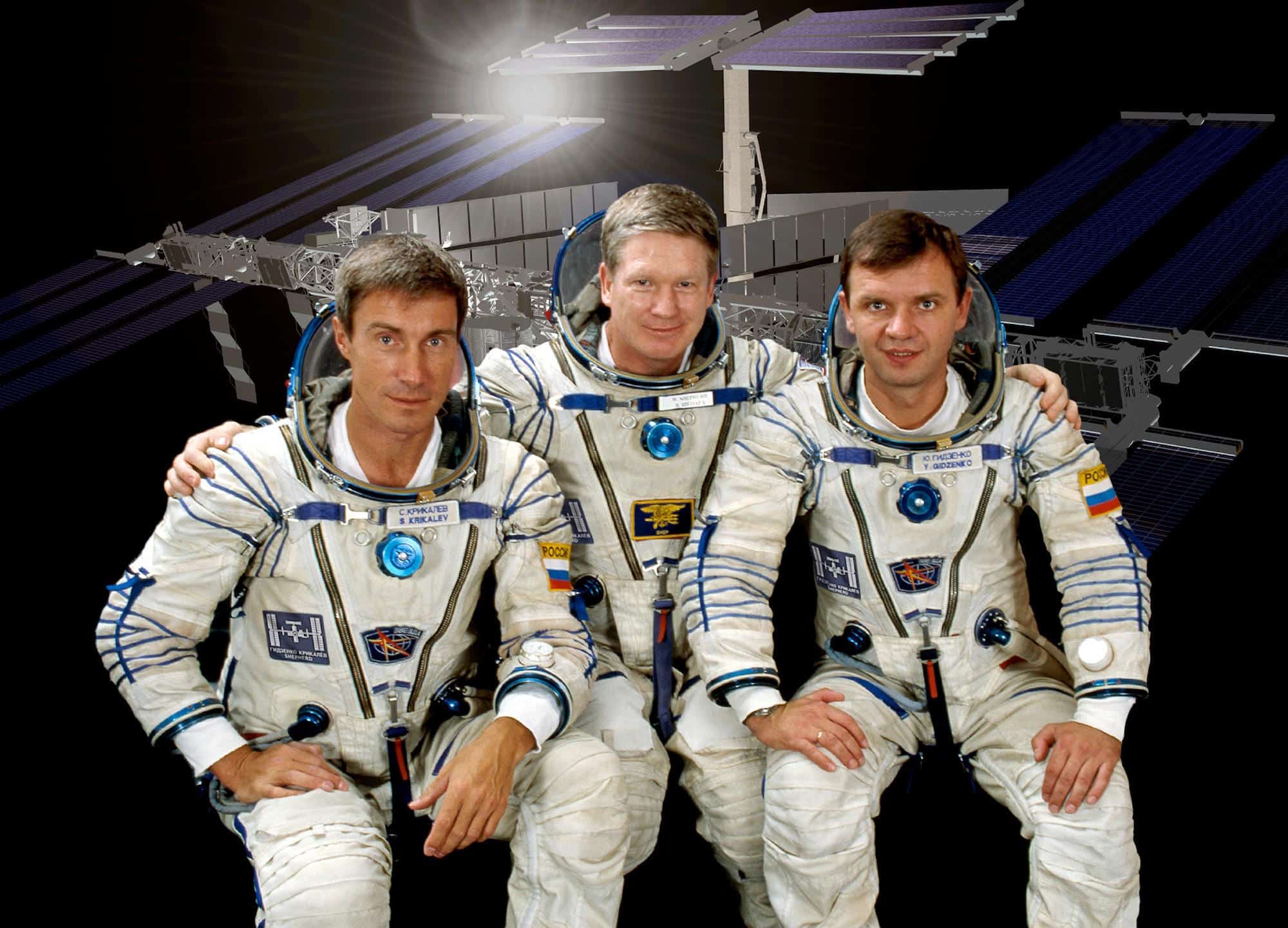
The first permanent ISS crew, Expedition 1 (from left to right): Sergei Krikalev, William Shepherd and Yuri Gidzenko. Image credit: NASA.
Today, we are at Expedition 45 which is made up of 6 people. In the meantime, the assembly of the space station by adding extra modules has increased its capacity and it can now therefore accommodate crews of 6 people.
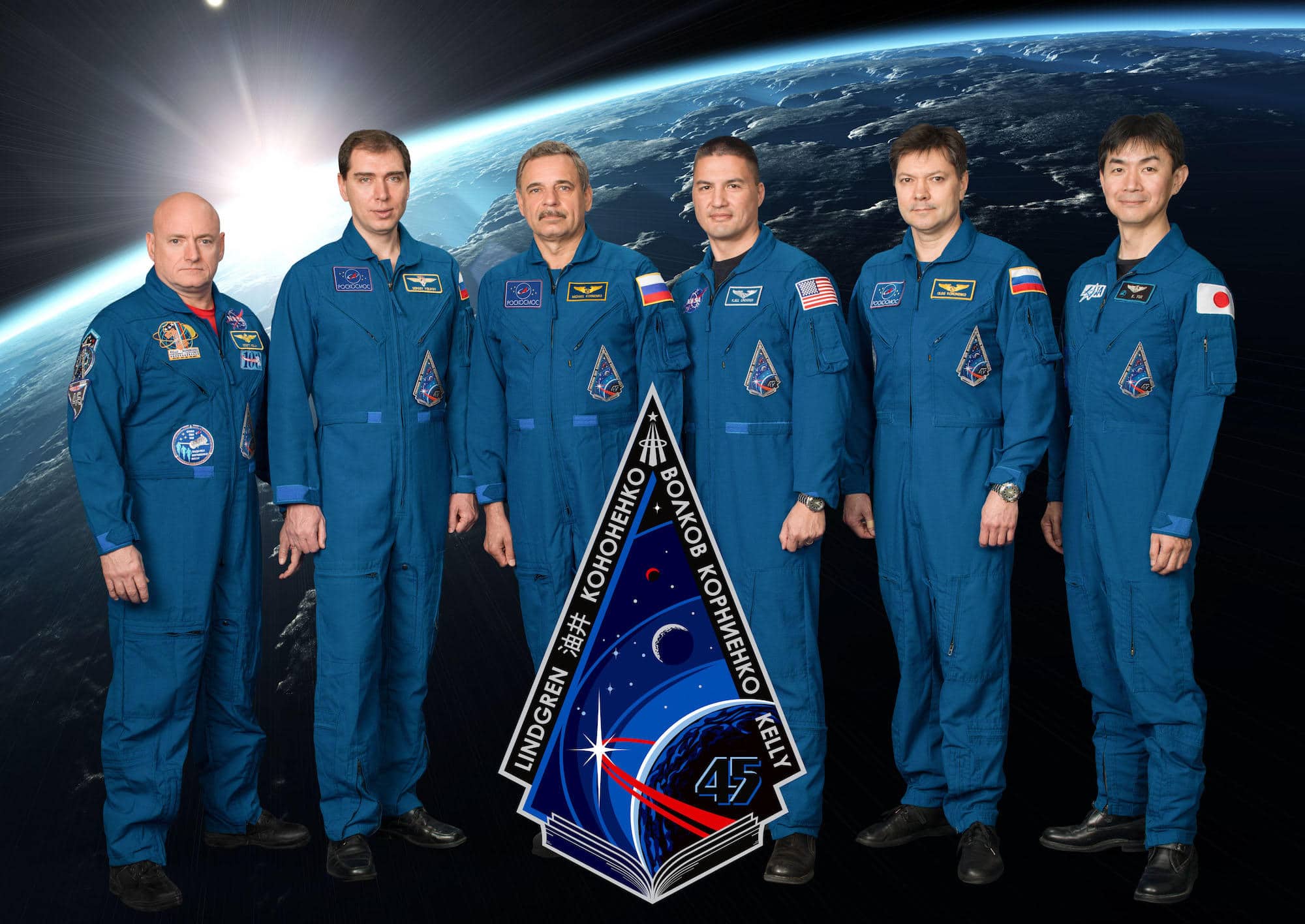
The current ISS crew, Expedition 45 (from left to right): Scott Kelly (commander), Sergei Volkov, Mikhail Kornienko, Kjell Lindgren, Oleg Kononenko and Kimiya Yui. Image credit: NASA.
The ISS is primarily a laboratory in orbit and the astronauts, in addition to taking care of its maintenance, perform experiments designed by scientists. Indeed, weightlessness allows research that could not be conducted on Earth where everything is subject to gravity. The Expedition members are also becoming guinea pigs for medical studies to determine the effects of long-term space travel.
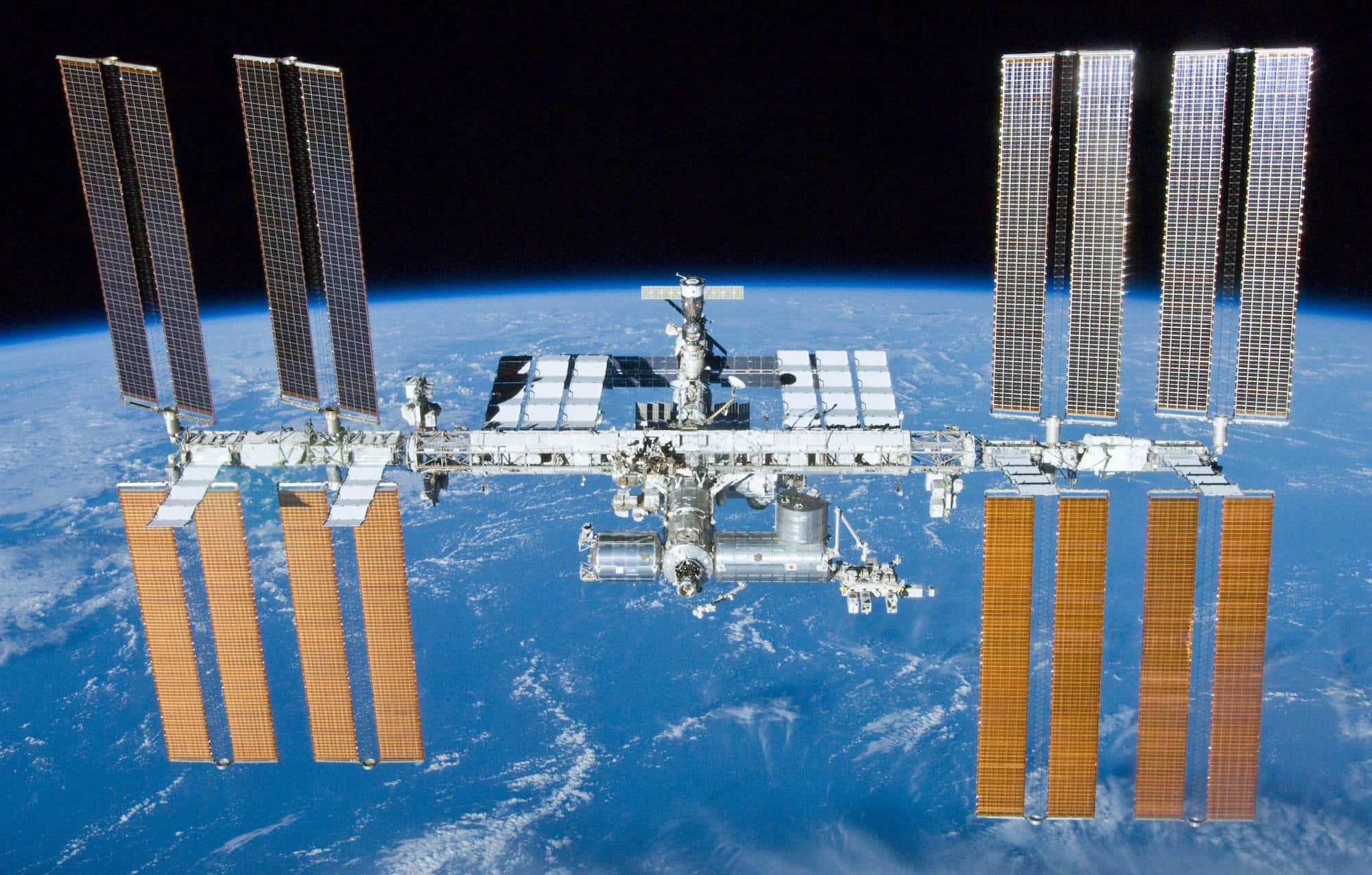
The International Space Station. The largest structure ever assembled in orbit has a total mass of 400 tonnes and orbits the Earth at an altitude of 400 km. The modules come from Russia, Europe, the United States and Japan. Canada supplied the principal robotic arm. Due to industrial agreements, half the space station’s pressurised modules were manufactured by Thales Alenia Space in Italy. Image credit: NASA.
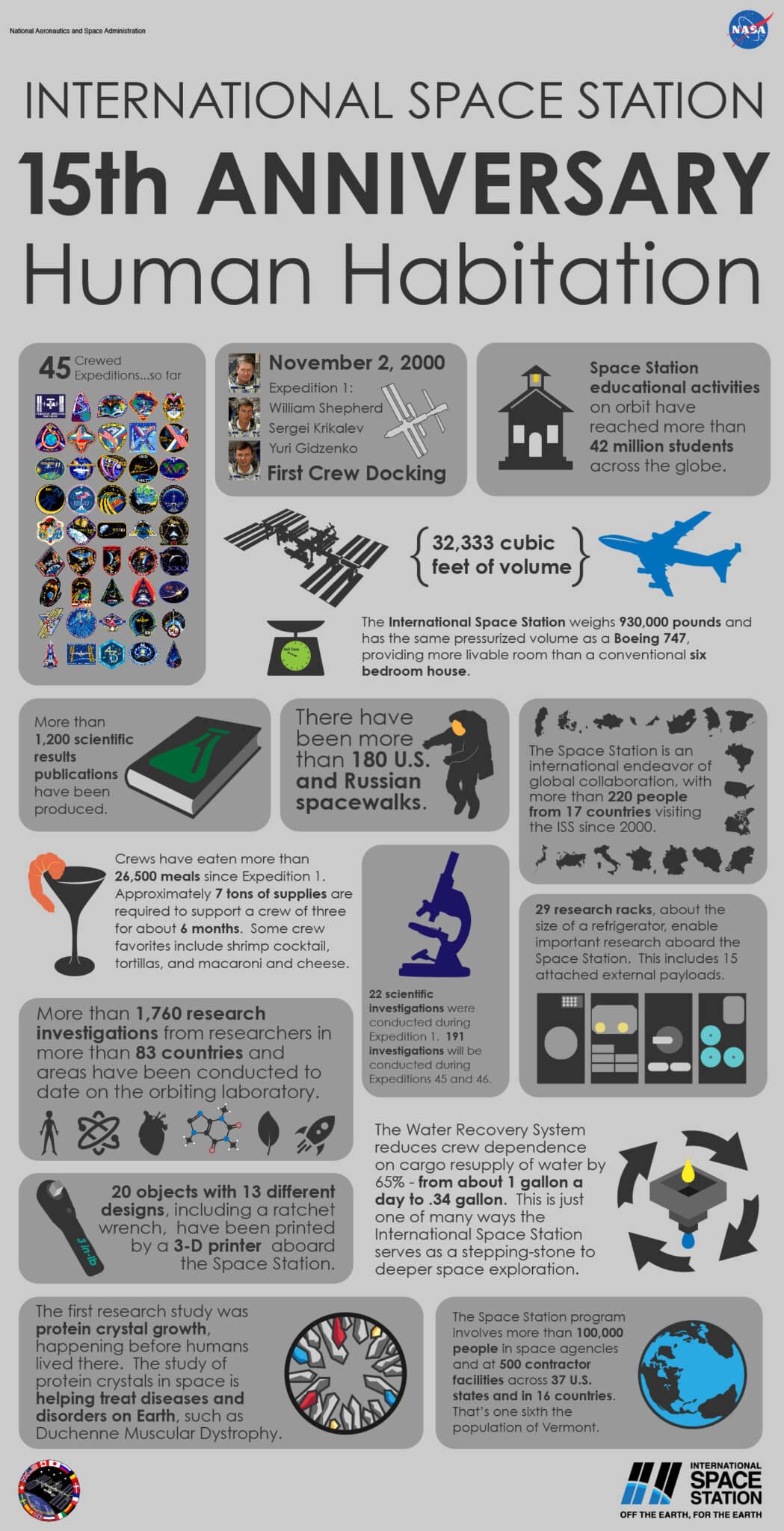
To celebrate the 15 years of permanent occupation of the ISS, NASA has created an infographic (reproduced at the end of the article) showcasing some of the most amazing figures. We therefore learn that more than 1,200 scientific publications have been produced from experiments conducted on the space station. It also measures the increasing importance of the ISS in terms of science since during Expedition 1, 11 scientific experiments were conducted while during Expeditions 45 and 46 (over the same duration of 6 months), 191 experiments will be completed. Offering the same internal volume as a Boeing 747, the ISS has been visited by 220 people from 17 different countries and its assembly has required more than 180 spacewalks to date. On board, 65 % of the water used by the astronauts and the onboard systems is recycled, a true practical test of solutions likely to help Earthlings to work towards sustainable development. Furthermore, the 6 astronauts are only the visible part of the human side of the programme; on the ground, 100,000 people work for the ISS. An aspect that the ESA astronaut Léopold Eyharts highlighted when we interviewed him at the 2015 International Paris Air Show (video below), when he talked about a “team of people with shared dreams and objectives and who are ready to give the best of themselves so that the programme is a success”.
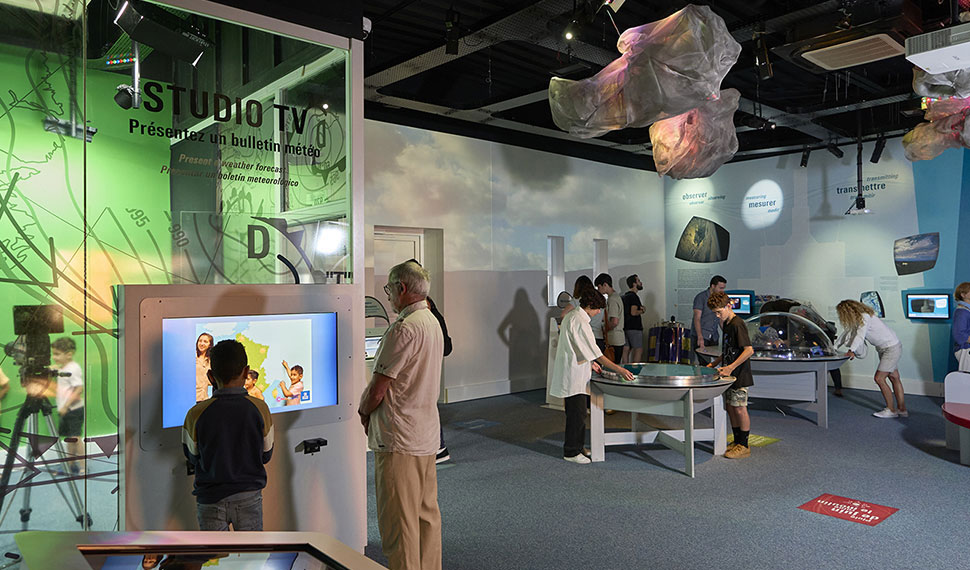
In this interview, Léopold Eyharts talks in particular about his 2008 mission during which he took part in the implementation of the ESA’s (European Space Agency) Columbus laboratory module. A sort of scientific research centre permanently in orbit, you can visit a full-scale replica of it at the Cité de l’Espace in Toulouse as part of its exhibitions.
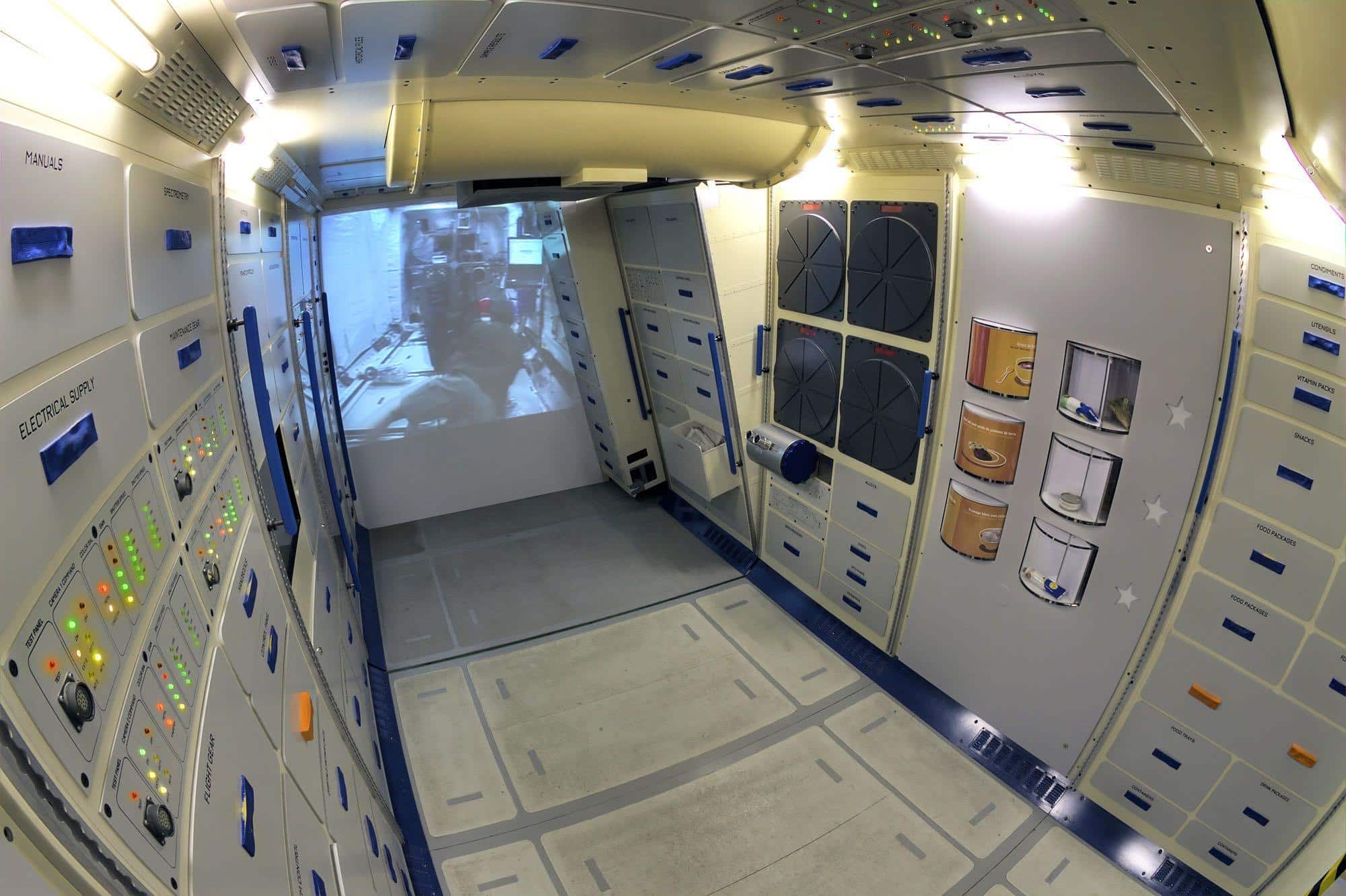
Full-scale reproduction of the European Columbus module of the ISS at the Cité de l’Espace in Toulouse. Image credit: Cité de l’Espace / Alex Pietcha
Everything surrounding this Earth-based version of Columbus, the models and interactive elements provide visitors with a range of information about the International Space Station.
In total, 15 European Space Agency (ESA) astronauts, including Léopold Eyharts of course, have visited the ISS. The Agency posted a montage on Twitter showing these 15 (from left to right and top to bottom): Samantha Cristoforetti, Christer Fuglesang, Andreas Mogensen, Alexander Gerst, André Kuipers, Paolo Nespoli, Caudie Haigneré, Léopold Eyharts, Frank De Winne, Hans Schlegel, Roberto Vittori, Pedro Duque, Thomas Reiter, Umberto Guidoni and Luca Parmitano.

The 16th will be Timothy Peake who is scheduled to take off next December.
Below, NASA’s infographic on 15 years of the ISS.